Instant Discount vs Cashback vs No-Cost EMI Explained
Open any Diwali sale page this week and the price comes with fine print: "10% instant discount on select bank cards", "₹1,500 cashback", "No-cost EMI for up to 9 months". Amazon restarted its festive sale as the Great Indian Festival Reloaded at midnight on 21 October, with bank discounts, cashback, exchange offers and no-cost EMI all listed side by side (FoneArena, 21 Oct 2026). Flipkart and the brand stores are running their own Diwali offers in the same style.
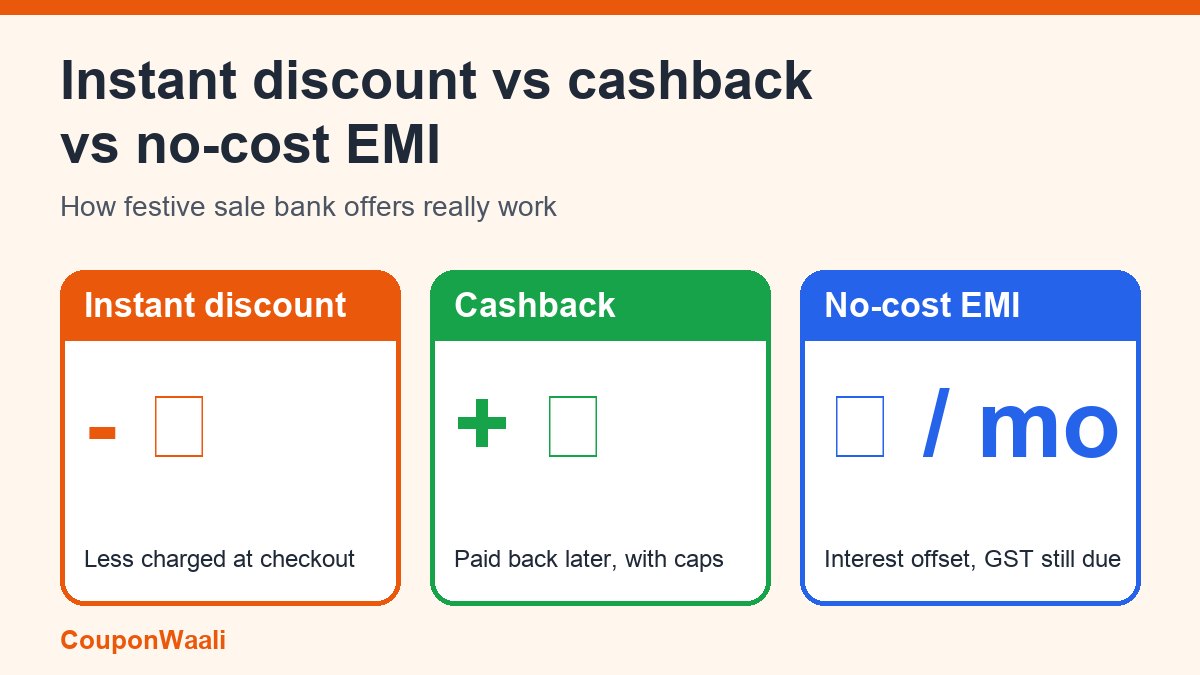
The short answer: an instant discount reduces the amount charged to your card at checkout. Cashback is paid back to you later, usually with caps and conditions. No-cost EMI is a small loan where a discount cancels out the interest, but you normally still pay GST on that interest and sometimes a processing fee. The best offer is simply the one with the lowest total you will actually pay, for the way you plan to pay.
Instant discount: money off before you pay
An instant bank discount is applied on the payment page when you choose an eligible card. It shows up as its own line, often labelled "bank offer" or "instant discount", and the amount debited from your card is lower. Of the three offer types it is the most straightforward, but the headline number hides several conditions:
- A percentage with a cap. "10% up to ₹1,500" stops at ₹1,500. On a ₹40,000 phone you get ₹1,500 off, not ₹4,000.
- A minimum transaction value. It is usually checked against the final cart value after other discounts, so a coupon can push you below it.
- Card type and payment mode. Credit card full payment, credit card EMI and debit card are often separate offers with different rates. Corporate and add-on cards are frequently excluded.
- Usage limits. Many offers allow one or two uses per card for the whole sale period.
If you return the product, the refund is normally the amount you actually paid, so the instant discount does not come back to you as cash.
Cashback: money back later, with conditions
With cashback you pay the full price today and receive part of it back afterwards. Where it lands matters as much as how much it is:
- Card statement credit is the closest thing to cash: it reduces your card bill.
- Wallet balance, gift card or store credit can only be spent on that platform, often within a fixed period. ₹1,000 of store credit is worth ₹1,000 only if you would have spent that money there anyway.
- Timing. The terms usually say "credited within X days", often after the return window closes, so it can take weeks.
- Reversal. If you return or cancel the order, the cashback is usually withdrawn or adjusted against the refund.
- Caps. There is often a maximum per card or per account for the entire sale, not per order.
Because it arrives later and depends on conditions, cashback is worth a little less than the same amount as an instant discount. It wins only when it is clearly bigger, or when it is paid as a statement credit.
No-cost EMI: a loan where a discount pays the interest
No-cost EMI splits the price into equal monthly instalments, typically over 3, 6 or 9 months. The card issuer still charges interest on the loan. What makes it "no-cost" is that the seller or brand gives you an upfront discount roughly equal to that interest, so your instalments add up to the listed price.
That structure leaves three costs that are easy to miss:
- GST on the interest. Interest charged by the card issuer attracts GST (currently 18%), which shows up on your card statements during the EMI period. The discount covers the interest, not the tax on it.
- A processing fee. Many card issuers charge a one-time EMI processing fee, plus GST on the fee. Some festive offers waive it; check the payment page.
- A smaller bank offer. If the full-payment bank discount is bigger than the EMI bank discount, choosing EMI costs you the difference.
The regulator noticed this a long time ago. In a circular dated 17 September 2013, the Reserve Bank of India observed that in zero percent EMI schemes on credit cards, the interest element is often camouflaged and passed on to the customer as a processing fee (RBI/2013-14/292). That is why today's offers are structured as interest plus a matching discount, and why your statement shows interest even on a "no-cost" plan.
A worked example on a ₹30,000 phone
Here is how the same purchase compares under the three offer types. The numbers are illustrative: a 10% instant discount capped at ₹1,500, a ₹1,500 cashback, and a 6-month no-cost EMI at an assumed 15% annual interest with a ₹199 processing fee. Your card's actual rate and fee will differ.
| Offer | What you pay | Effective cost |
|---|---|---|
| Instant discount (full payment) | ₹28,500 today | ₹28,500 |
| Cashback as store credit | ₹30,000 today, ₹1,500 credit in a few weeks | ₹28,500 only if you spend the credit there; otherwise ₹30,000 |
| No-cost EMI, 6 months | 6 × ₹5,000, plus about ₹229 GST on ₹1,270 interest, plus a ₹199 fee and ₹36 GST on it | About ₹30,464 |
In this example, EMI costs about ₹1,964 more than paying in full with the instant discount. That is the price of spreading the payment. Sometimes it is worth it, but it should be a deliberate choice, not something the word "no-cost" decides for you.
How to compare offers in two minutes
- Go to the payment page. Bank offers often only appear there, and the final amount differs by card and by payment mode.
- Turn every option into one number: the total you will actually pay. Subtract an instant discount. Subtract cashback only if it is a statement credit or credit you will definitely use. Add EMI GST and any processing fee.
- Read the offer terms: eligible cards, minimum order value, maximum discount, uses per card and the offer dates.
- Check the base price. A big bank discount on an inflated price is not a deal. Compare with the price before the sale started.
- Stay within budget. If you might miss an instalment, skip EMI. Late fees and interest on an unpaid card balance cost far more than any festive discount.
When a bank offer does not apply
The usual causes are close cousins of coupon failures: the wrong card variant (debit instead of credit, or a corporate card), the cart falling below the minimum after a coupon, choosing EMI when the offer is for full payment (or the other way round), splitting the payment across methods, or the per-card limit already being used up. Our guide to why a coupon code is not working walks through the same checks step by step, including bank offers that will not stack with a promo code.
Which one should you pick?
- Paying in full, and your card has an instant discount? That is usually the best value.
- Cashback beats it only when it is clearly larger or paid as a statement credit you can rely on.
- No-cost EMI makes sense when you genuinely need to spread the cost and you always pay your card bill in full. Add the GST and fee, and compare the result with the full-payment price before you choose it.
One safety rule applies to all three: no genuine offer ever needs your OTP, CVV or card PIN over a call or message. A caller offering to "activate" your cashback or EMI benefit is a scam.
FAQ
Is no-cost EMI really free?
Not completely. The discount offsets the interest, but GST on the interest, and often a processing fee, are still payable. You may also give up a bigger instant discount that is only offered on full payment.
Do I lose cashback if I return the product?
Usually yes. Cashback is tied to a completed order, so returns and cancellations normally reverse it or reduce your refund. Check the offer terms before you buy.
Can I use a coupon code and a bank offer together?
Often, but not always. Some coupons exclude bank offers, and a coupon can drop your cart below the bank offer's minimum value. Compare the final payable amount with and without the coupon.
Sources: Reserve Bank of India circular RBI/2013-14/292, 17 September 2013; FoneArena: Amazon Great Indian Festival 2026 Reloaded, 21 October 2026. Offer terms change during the sale, so always check the live terms on the payment page. More guides on the CouponWaali blog; how we work: About CouponWaali and our disclaimer.