Flipkart Big Billion Days vs Amazon Great Indian Festival: How the Sales Work
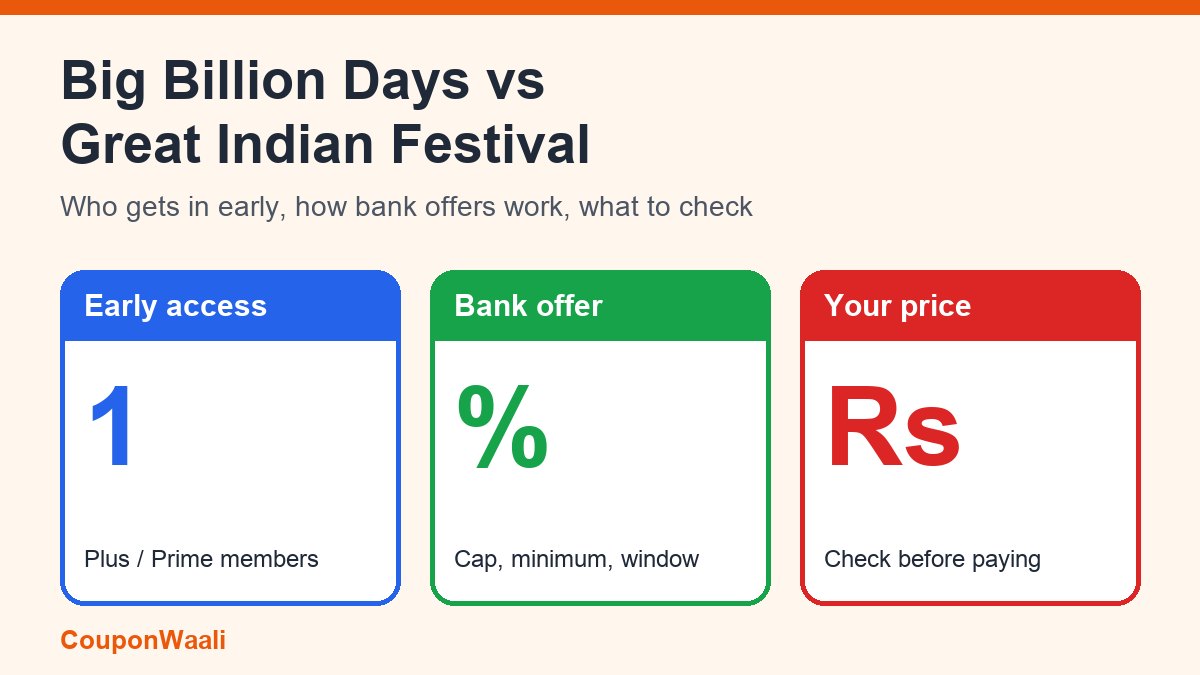
Flipkart's Big Billion Days and Amazon's Great Indian Festival look alike from the outside: a few weeks of big banners, "lowest ever" tags and bank logos. Under the banners they work differently, and the differences decide what you actually pay. This guide explains how each sale is structured, who gets in early, how the bank offers behave, and a simple order of checks so you use the sale instead of being used by it.
The short answer: both sales run on the same three levers, a sale price, a card or bank offer and an exchange or EMI option, but the access rules differ. Flipkart gives a head start to Plus and Black members on an "Early Access Day". Amazon gives a head start to Prime members. The bank offers are set by the banks, come with minimum order values and caps, and change during the sale. The dates change every year, so never trust a date from last year's article.
How the 2026 sales were timed
Amazon's Great Indian Festival 2026 began on 8 October 2026, and reports said Prime members could shop about 24 hours earlier, on 7 October (Indian Express). For Flipkart, Plus and Black members were expected to get early access on 8 October with the wider Big Billion Days sale opening on 9 October (Goodreturns). Flipkart's own Plus page says it announces major sale events two to three weeks ahead through the app, and that Early Access Day always falls one day before the official start.
The practical lesson: the real "start" depends on who you are. If you are not a member, the first day of the sale is already the second day for someone else, and the most popular stock may be gone.
Who gets early access, and what it costs
On Flipkart, early access belongs to the Plus programme. According to Flipkart's Plus terms page, there are two tiers: Plus Silver after 15 successful transactions in the past 365 days and Plus Gold after 25. The page adds that you may also be required to buy the membership from Flipkart or its partners, so check what the app asks of you rather than assuming it is automatic. Early access covers select products for a few hours, and it is available to Plus and Black members only.
On Amazon, early access is tied to a Prime subscription. Prime is a paid membership, so whether early access is worth it depends on whether you would have bought it anyway for delivery and video. Buying a subscription only to catch one sale rarely makes sense unless the one item you want is large and likely to sell out.
For most shoppers the honest comparison is this: early access helps when you want a specific, popular, limited-stock item. For everything else, prices a day or two later are usually in the same range.
How the bank offers actually work
The biggest numbers in a sale usually come from card offers, so they are worth reading carefully. Take SBI Card's Amazon festive offer for 2026 as a worked example of the typical terms (SBI Card offer page):
- A fixed window. The offer ran from 8 October to 20 October 2026, and its terms say it can be revoked or extended by Amazon without prior notice.
- A percentage with a cap. A 10% instant discount on select products, with a maximum discount per period. The page notes the base offer could be used 8 times during the window and that it was refreshed on specific dates, so a limit used up on day one does not come back on day two.
- A minimum order value. ₹4,990 for mobiles and ₹2,490 for other categories, per transaction and inclusive of taxes. A ₹4,900 phone would not qualify.
- Extra bonus offers by price band. Flat extra discounts at steps such as ₹14,990, ₹49,990 or ₹99,990, some only on EMI transactions. Spending a little more to cross a band can look attractive, so always compare the extra discount with the extra cost of the more expensive product.
- A hidden trade-off. The terms say reward points earned on offer-eligible transactions are forfeited. If your card normally gives you points, the instant discount is not "free": you give up the points. Our guide to reward points versus cashback shows how to put a rupee value on those points.
Flipkart's Plus programme has its own layer. Its terms page says Plus Silver members get a 12% instant discount and Plus Gold members 15%, up to the offer limit, on partner-bank cards, but only on Early Access Day of major sales, and the bank partners are revealed ahead of the sale. It is applied automatically at checkout if you pay with an eligible card, and you do not need to link the card to your account. On normal sale days the base offer for non-members is lower.
If an offer does not apply when you pay, the reasons are usually mundane. Our checklist on why a bank offer does not apply at checkout covers the common ones: wrong card type, minimum value, per-day limit or a payment method that is excluded.
Sale price, exchange and EMI: the other levers
- Sale price. It is the same for everyone, but it can move during the sale. Before you trust a "lowest ever" tag, run the checks in how to check if a Diwali discount is real.
- Exchange. You trade in an old device for a credit. The amount depends on the model and on the condition you declare, and inspection can change it. Our worked example in the real price of a phone in a Diwali sale shows how a headline price can end several thousand rupees higher.
- EMI. No-cost EMI spreads the payment, it does not shrink the price. See instant discount vs cashback vs no-cost EMI for how the discount is usually built into the EMI maths.
A checklist before you pay in any big sale
- Decide the product first. Pick the exact model and variant you want before the sale starts, so a banner cannot choose for you.
- Note the price for two or three weeks before. A screenshot or a price-history page tells you what "sale" really means.
- Find out whether you qualify for early access and whether it matters for your item. If not, do not rush.
- Read the bank offer terms on the bank's page, not just the banner: window, cap, minimum value, per-day limit, eligible products and whether reward points are forfeited.
- Work out the price for your situation. Count the bank offer only if you hold the card, and the exchange only if you will hand over a device.
- Compare the same variant on the other app and offline. The two sales run at the same time for a reason.
- Test the product on day one and keep the invoice, and check the product page for the replacement or refund window that applies to that category.
FAQ
Which sale is cheaper, Big Billion Days or Great Indian Festival?
Neither is cheaper across the board. Prices vary product by product and day by day, and the bank offer you can use matters as much as the sticker price. Compare the final price for your exact variant on both apps.
Do I need Flipkart Plus or Amazon Prime to buy in the sale?
No. Membership is for early access and some extra perks. Anyone can buy once the sale opens to the public, subject to stock.
Can I use more than one bank offer on the same order?
Usually one card offer applies to an order, though some banks stack a base offer with bonus offers as the SBI Card terms above show. The payment page shows what applies to your card before you confirm.
How long does the sale last?
It varies each year, and platforms announce the schedule shortly before. Bank offers can end earlier or later than the sale itself, as the SBI Card terms show, so check the offer window as well.
Will prices drop again after the sale?
Sometimes, because brands and sellers run smaller sales afterwards, but there is no guarantee. If the price you worked out meets your budget, buying is usually better than waiting for a small extra saving.
Sources: Flipkart Plus programme terms; SBI Card: Amazon festive offer terms; Indian Express; Goodreturns (all read 8 November 2026). Offers and terms change often, so check the live terms on the product page and at checkout. More guides on the CouponWaali blog; how we work: About CouponWaali and our disclaimer.