Fake Discounts in Diwali Sales: How to Check if a Deal Is Real
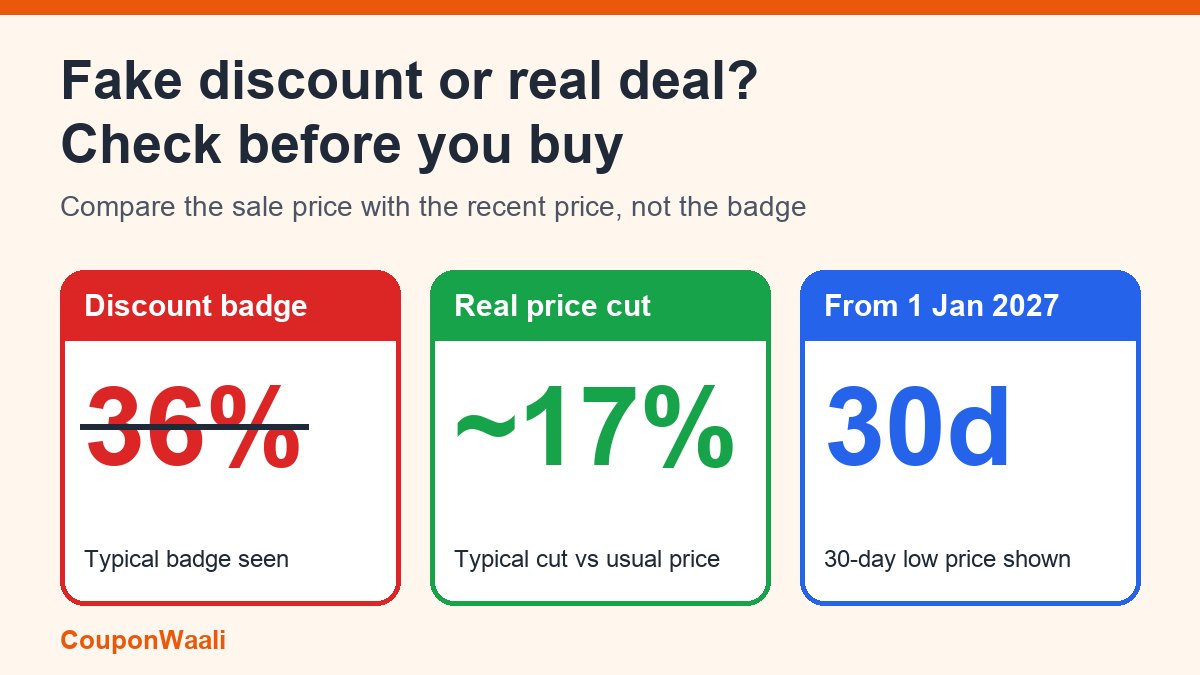
A ₹999 trimmer marked "36% off". A TV with a struck-out price that nobody ever seems to have paid. During the Diwali sales, discount badges are everywhere, and it is fair to ask how many of them are real. A price-tracking study reported by Moneylife on 19 October 2026 gives a useful, sober answer: many sale prices really are lower than before, but often by much less than the badge suggests (Moneylife, 19 Oct 2026).
The short answer: a "fake discount" is usually not an invented price cut but a discount measured from the wrong starting point, such as the printed MRP or a price that was raised just before the sale. To check a deal, ignore the percentage and compare the sale price with what the same item, from the same seller, actually cost in the weeks before the sale. Then check the final amount on the payment page, after fees and before any bank offer you are not sure of.
What the price data shows
The price-tracking site RateLens looked at 252 price records for 185 grooming products on Amazon and Flipkart, comparing each product's sale low with its own usual price on the same platform in the weeks before the sale. According to the Moneylife report:
- 121 records had a sale low at least 10% below the usual pre-sale price. The typical cut in this group was about 17%.
- 118 records were within 10% of the usual price, so the "sale" changed very little.
- 13 records were at least 10% above the usual price.
- In a separate check of 254 sale prices between 8 and 13 October, the typical discount badge said 36%.
So genuine savings exist. A Philips hair dryer in the study, usually ₹999, hit ₹629 at its sale low. But a typical real cut of around 17% next to a typical badge of 36% shows why the badge alone is a poor guide. RateLens itself points out the limits: it is a small, preliminary sample, prices were checked on selected days rather than continuously, bank offers and coupons were left out, and it is not a finding that any platform or seller broke the rules.
How a discount ends up looking bigger than it is
- Measured against MRP. The MRP is the maximum price printed on the pack, not the price the item normally sells for. Many products sell well below MRP all year, so "50% off MRP" can simply be the everyday price.
- Price raised before the sale. If the price goes up in the weeks before a sale and then "drops", the cut looks large but you pay roughly what you would have paid anyway.
- A different variant or seller. The low price may apply to one colour, a smaller storage version, an older model or a different seller with a weaker return policy.
- The bank offer counted in. Some listings show an "effective price" that already assumes a card offer you may not have. Our guide to instant discount vs cashback vs no-cost EMI explains what each type of bank offer is really worth.
- Fees added at checkout. Handling, platform or cash-on-delivery fees that appear only on the last screen shrink the saving. E-commerce platforms drew 5.1 lakh complaints on the National Consumer Helpline in 2025 alone, and the amended rules now also bar marketplaces from charging bundled fees for unrelated services (MediaNama, Sep 2026).
- Pressure instead of price. Countdown timers and "only 2 left" labels push you to decide before you compare. India's 2023 dark-pattern guidelines list false urgency among 13 deceptive design practices.
A five-minute check before you buy
- Ignore the percentage. Note the actual sale price in rupees and forget the badge for now.
- Find the usual price. The best evidence is your own: if you added the item to your cart or wishlist before the sale, compare with that. A price-history tracker or a price-drop alert also works. Treat browser extensions with care and give them only the permissions they really need.
- Match the exact product. Compare the same model number, size, colour and storage on other marketplaces and on the brand's own store. Search by model number, not by product name.
- Check the seller. On marketplaces the cheapest listing may not come from the main seller. Look at the seller name, rating, warranty terms and return window.
- Go to the payment page. Add every fee, then subtract only the bank offer or coupon you are sure will apply. If a coupon fails at this stage, our guide to why a coupon code is not working covers the usual reasons.
- Decide on the rupees saved. Saving ₹300 on a ₹1,000 item is meaningful. Saving ₹300 on a ₹40,000 phone is not worth a rushed choice, a weaker warranty or a model you did not want.
One simple rule settles most cases: if you would not buy the item at the sale price without the badge, the discount is not a reason to buy it.
What changes from 1 January 2027
The Department of Consumer Affairs amended the Consumer Protection (E-Commerce) Rules in September 2026, and the changes come into force on 1 January 2027 (MediaNama; Moneylife). The parts that matter most for shoppers:
- Prior price next to every announced price cut. When a platform announces a price reduction, it must show the reduced price alongside the "prior price", defined as the lowest price at which the product was offered in the 30 days before the reduction was announced.
- Clearly labelled sponsored listings. Paid placements must be clearly and prominently disclosed, and search results must not be manipulated in a misleading way.
- Dark-pattern checks. Platforms must follow the 2023 dark-pattern guidelines, run a yearly self-audit and display a compliance certificate.
- Better complaint handling. Platforms must join the National Consumer Helpline's convergence programme and give you a copy of your complaint as recorded by their grievance officer.
The 30-day rule will not force any price down, and it will not tell you whether a product is good value. It gives you an honest benchmark. Until it applies, the Diwali sales running up to 8 November and the year-end sales still run on the old labels, so the five-minute check above is your benchmark for now.
Fake discount or fake shop?
A misleading discount on a real marketplace costs you some money. A fake shop can cost you all of it. Online shopping scams were the most commonly reported scam type in India in the GSMA India Consumer Scam Report 2026, at 33%, and AI now makes fake sale ads and look-alike stores easier to produce (Storyboard18, 23 Oct 2026). Warning signs:
- The offer reaches you through a social media ad, a forwarded message or an unknown link rather than the official app or website.
- The web address is slightly different from the real brand or marketplace.
- The price is far below every other seller, often with a "today only" timer.
- Payment is requested by direct UPI or bank transfer instead of the site's normal checkout.
- Anyone asks for your OTP, card PIN or CVV to "unlock" an offer. No genuine offer ever needs them.
If you have lost money to a fake shop, call the cyber fraud helpline 1930 or report it at cybercrime.gov.in as quickly as possible, and tell your bank at once.
If you think a discount was misleading
Start with the platform: raise a complaint through its help section or grievance officer and keep screenshots of the listing, the price and your order. If that does not resolve it, the National Consumer Helpline (1915) takes complaints against e-commerce sellers and platforms before they become legal cases.
FAQ
Is the MRP the real price of a product?
No. The MRP is the maximum price the product may be sold for. The useful reference is what the same item usually sold for shortly before the sale.
Are Diwali sale discounts fake?
Usually the price cut is not invented, but it is often smaller than it looks. In the RateLens sample, about half of the sale lows were at least 10% below the usual price, and most of the rest barely moved. Compare rupees with the recent price instead of trusting the percentage.
Do the new price rules apply to this year's sales?
No. The amended e-commerce rules, including the 30-day prior-price display, come into force on 1 January 2027.
Sources: Moneylife: Big Discount Tags, Smaller Price Cuts? RateLens Tracks 252 Online Prices Ahead of New Rules, 19 October 2026; MediaNama: India Amends E-Commerce Rules on Dark Patterns, Pricing, September 2026; Storyboard18: AI supercharges festive shopping scams as fake deals put consumers and brands at risk, 23 October 2026. Prices and offers change during a sale, so always check the live listing. More guides on the CouponWaali blog; how we work: About CouponWaali and our disclaimer.