Reward Points vs Cashback on Indian Credit Cards: Which Pays More?
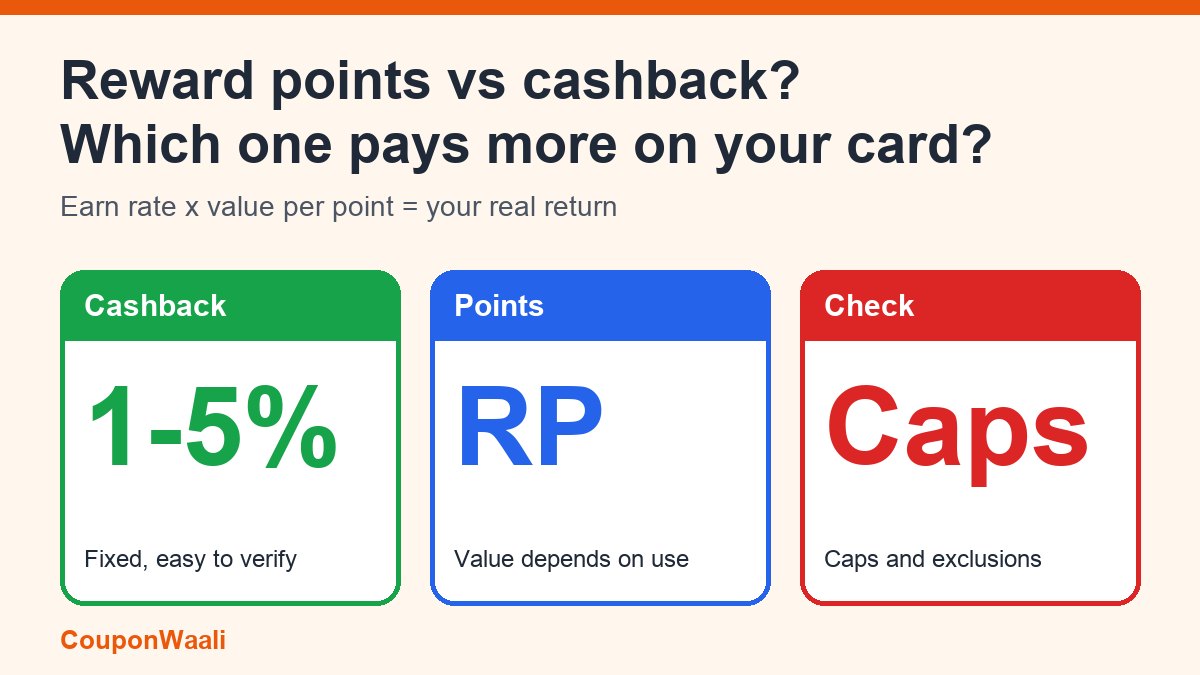
Two cards can both advertise "rewards" and still pay you very differently. One credits a flat percentage back as cashback. The other gives points that are worth a different amount depending on where you spend them. If you are picking a card for a sale, or wondering whether the points you have collected are worth using, you need one number: what a rupee of spending actually returns to you.
The short answer: cashback is simpler and its value is fixed, so it is easy to trust. Points can be worth more, but only if you redeem them in the best way and the card's earn rate beats a plain cashback card. The same points can be worth ₹0.65 each in one place and ₹0.15 in another, so the redemption value matters as much as the earn rate. Work it out as earn rate × value per point, then subtract the limits.
How cashback works
Cashback means a percentage of your eligible spend comes back to you as money or something close to money: a statement credit, a balance in an app wallet, or a credit to your account. The percentage is usually stated up front, and the rupee value is known the moment you earn it.
Real examples, as published by the banks (they change, so read the current page):
- Amazon Pay ICICI Bank Credit Card: ICICI Bank's page lists 5% cashback on Amazon shopping for Prime members and 3% for non-Prime members (excluding Gold Coins), 2% on Amazon Pay categories, and 1% on other spends outside Amazon, excluding fuel, rent, tax, education, utilities and international spends.
- Flipkart Axis Bank Credit Card: Axis Bank's page lists 5% cashback on Flipkart and Cleartrip spends, capped at ₹4,000 per statement quarter per merchant, unlimited 4% on its preferred merchants, and unlimited 1% on other eligible categories (an earlier Axis press release quoted 1.5% on other spends, a good example of how rates get revised).
Look at the fine print in both: the headline rate applies to one store or category, the rest of your spending earns far less, and some spend types earn nothing. The Flipkart card's 5% stops at ₹4,000 in a statement quarter, which is the cashback on ₹80,000 of spending at that merchant. That is generous for most households, but it is a cap.
How reward points work
A points card pays in its own currency. You usually earn a number of points per fixed amount spent, for example 5 points for every ₹200. That earn rate says nothing about rupees until you know what a point is worth, and that depends on how you redeem it.
HDFC Bank's Regalia Gold page is a clear example. It lists 5 Reward Points per ₹200 spent on retail, and a table of what one point is worth:
- Exclusive Gold Catalogue on SmartBuy: ₹0.65 per point
- Flight and hotel bookings: ₹0.50 per point
- Airmiles conversion: up to 0.5 airmile per point
- Products and vouchers: up to ₹0.35 per point
- Statement balance: up to ₹0.15 per point (another part of the same HDFC page says up to ₹0.20, a reminder to check the current table before you redeem)
The page also says you can redeem up to 70% on travel bookings using points and that the maximum points earned in a statement cycle is 50,000. Points, in other words, come with rules on where they work and how much of a purchase they can cover.
A worked example: ₹50,000 of everyday spending
Suppose you spend ₹50,000 in a month on things that are not tied to one shopping app. Using the published rates above (and ignoring annual fees, which you must check separately):
- A 1% cashback card: ₹500. The Amazon Pay ICICI card's rate outside Amazon is an example.
- A points card at 5 points per ₹200: 1,250 points. At ₹0.65 each that is ₹812.50; at ₹0.50 it is ₹625; at ₹0.15 it is ₹187.50.
The same spending, the same card, and the result swings from ₹187.50 to ₹812.50 depending on redemption. A points card used well beats a basic 1% cashback card. Used for the easiest redemption, it can lose to it.
Now the store-specific side. Spend ₹50,000 on Amazon as a Prime member with the Amazon Pay ICICI card and the stated 5% would be ₹2,500, or ₹1,500 at 3% for a non-Prime member, before exclusions. Spend ₹50,000 on Flipkart with the Flipkart Axis card and 5% would be ₹2,500, inside the ₹4,000 quarterly cap. Those figures only apply if the spend qualifies, so read what is excluded.
Five checks before you compare two cards
1. Convert everything to a percentage
Points per ₹100 or ₹200 are not comparable across cards. Multiply the earn rate by the value of a point in the redemption you will actually use, and compare that percentage with a cashback rate.
2. Read the exclusions
Fuel, rent, tax, education, utilities, wallet loads, gold and EMI conversions are often excluded or earn at a reduced rate. The Amazon Pay card page lists several of these, so a "5%" card can pay nothing on the spend you most want rewarded.
3. Check the caps
Monthly, quarterly and per-merchant limits turn a good rate into a bad average once you reach them. Know where yours stops.
4. Check how you redeem
The best value is often a travel or catalogue redemption that takes effort, while the quick option (a statement credit) pays the least. If you will never plan a flight around your points, use the statement-credit value in your calculation.
5. Find out what happens on a return
Cashback and points earned on a purchase can be reversed if you return it. If you often return sale items, count the reward only after the return window closes. We explain the timing in our guide to when cashback is credited and what to do if it is not.
When each one wins
- Cashback usually wins if you want a predictable return, spend mostly at one store the card is built around, or do not want to manage redemptions.
- Points usually win if you spend across many categories, will redeem for travel or high-value catalogue items, and have checked the redemption values.
- Neither wins if you carry a balance. Card interest usually costs far more than any reward you earn, so paying the bill in full matters more than the card you pick.
This is general information, not financial advice. Bank terms, fees and rates change, so confirm them with the issuer before you apply for or use a card.
Reward cards and sale offers are different things
Everything above is about the card's ongoing rewards. A sale's bank offer is a separate benefit: an instant discount at checkout or a cashback tied to that event. They can stack, and the sale offer can disappear at checkout for reasons covered in our guide to why a bank offer does not apply. For the discount types themselves, see Instant Discount vs Cashback vs No-Cost EMI Explained. And before any reward calculation, check that the starting price was real with our fake discount check.
FAQ
Are reward points worth more than cashback?
Only sometimes. A point has no fixed value: on HDFC's Regalia Gold page it ranges from up to ₹0.65 down to ₹0.15 depending on how you redeem it. Multiply the earn rate by the value you will really get, and compare that percentage with the cashback rate.
Does cashback still count if I pay by EMI?
Often not at the full rate. Amazon's help page for the Amazon Pay ICICI card lists EMI transactions, and purchases converted to EMI after the purchase, among the spends excluded from the 3% store cashback. Check the exclusions of the card you hold.
Do points expire?
Many programmes set an expiry or change their terms from time to time. Look for the validity of points in the card's reward terms and set a reminder before they lapse.
Can a bank change the value of points?
Programme terms are usually the bank's to revise, which is why you should check the current redemption table before you plan around a particular rate. Cashback at a stated percentage is easier to verify. The Reserve Bank of India's master direction sets the general and conduct rules for credit, debit and co-branded cards; if a bank changes terms on you, start with the bank's grievance process before escalating.
Sources: ICICI Bank: Amazon Pay and ICICI Bank renew partnership (2025); Amazon.in Help: About Amazon Pay ICICI Bank Credit Card; Axis Bank: Flipkart Axis Bank Credit Card features; Axis Bank press release on the Flipkart Axis card; HDFC Bank: Regalia Gold Credit Card; Reserve Bank of India: Master Direction on credit and debit cards (all read 2-3 November 2026). Offer terms change often, so always read the terms on the card you are considering. More guides on the CouponWaali blog; how we work: About CouponWaali and our disclaimer.